You must log in or # to comment.
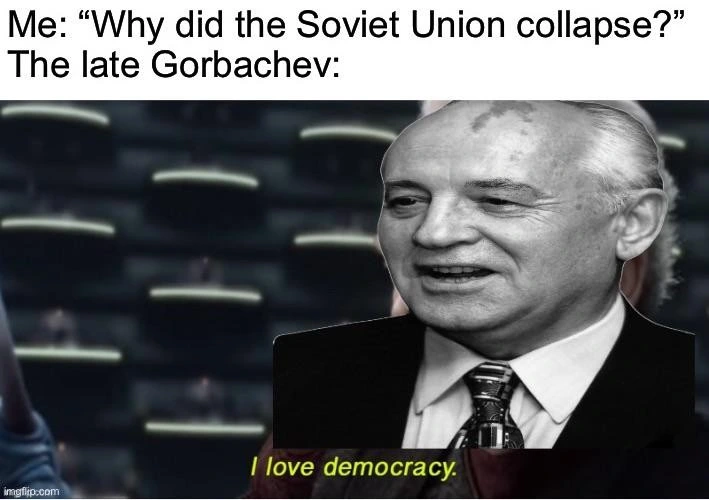
Explanation: As a professor of mine was fond of saying, Gorbachev’s reforms ultimately failed because he was the first Soviet premier who actually believed in the Soviet Union.
Not a believer in an abstract Bolshevik revolution - Lenin and Khrushchev were both true believers of that revolutionary stripe. Not a believer in the strength of the Soviet Union - certainly Stalin and Brezhnev believed in the strength of the apparatus. A believer in the structure of the Soviet Union itself, as it was sold to the people of the Soviet Union.
He was the first premier who grew up entirely under the rule of the Soviet Union - from childhood, he had known no other polity. So as he climbed the ranks of the Party, what he saw was not just a horribly corrupt and repressive apparatus, but an offense to what the Soviet Union was supposed to be. He played his cards carefully to maneuver into power, and when he assumed control of the Soviet Union, his political reforms were largely oriented towards delivering to the Soviet people what the Soviet Union had already, by law, promised them for decades - their rights and participation in a democratic workers’ state. To Gorbachev, he was only righting an institution which had been misled by bad faith actors, not fundamentally tearing down and re-creating a system rotten to the core.
… unfortunately for Gorbachev, the Soviet Union, and probably the world as a whole, massive institutions do not about-face on a dime. Gorbachev wanted to be, and was, a reformer, and his policies were nominally reformist, given the extant laws of the Soviet Union; but his changes were practically revolutionary for the Soviet state, and Gorbachev had neither the power nor charisma of a revolutionary. Combined with the extremely poor economic state of the Soviet Union in the 1980s, Gorbachev’s policy of glasnost - transparency, truth in government, and free communication between the people - would ultimately sink the Soviet project, shattering it into a dozen countries, and leaving the survivors all with varying degrees of distaste towards the old ‘Communist’ project as a whole as a perpetuation of Russian imperialism.
Tankies, naturally, fucking despise Gorbachev for attempting to do the right thing and give power back to the workers.
Personally I think no matter who it was any deviation from the institutional norm of the buerucratic oligarchy to a genuine worker democracy was doomed to fail. That the moment the Soviet people where given their self determination they would look to walk away since the USSR had just been nothing but a boot on their neck.
There were certainly periods when genuine enthusiasm for the Soviet Union - or hope for what it could be, at least - did express itself. And people are willing to endure a lot, so long as they still have hope.
But given the downturn of the 70s, the deteriorating situation of the 80s, and the sudden revelation by glastnost that capitalist countries were actually living much freer and materially better lives and that the Soviet structure was (as ordinary Soviet citizens suspected, but none of them could previously prove) mega-fucked, there was no hope left.