Japan doesn’t have socialized medicine. They have universal care. The government pays 70%. The user pays 30%. The insurance is provided through your employer. The doctors are private practice and not government employees.
Guns are not banned but heavily restricted.
Japan doesn’t have socialized medicine. They havle universal care. The government pays 70%.
So the payment for healthcare is socialised. In low income households the government waives the 30% copay. Everyone is covered by law and fees are set by the government. All hospitals must be run as non-profits.
Guns are not banned but heavily restricted.
Handguns are completely banned which are the type of gun used in most crimes in the US. Rifles and shotguns are heavily restricted.
No, the health care does not meet the criteria for socialized medicine unless you want to ignore the meaning of words to create a new definition. Using your definition, America has socialized medicine. The Japanese system is closer to the American system than it is to the NHS, which is a socialized system.
I said firearms are restricted. That isn’t the same thing as a ban. The main reason Japan has such a low crime rate is its very conservative society.
The system isn’t that different than the American system. To call in a socialist system is factually wrong. The doctors are in private practice. The employer provides your insurance. If you can’t afford it or are elderly, it is provided. We have Medicaid and Medicare, which are the same thing. The only difference is that they are 70/30, and we are 80/20 in most cases.
If they proposed that system in America, it would be a step backwards for most people.
I am against Socialized healthcare. The NHS is a failure. Our current system works fine for most Americans. What many American don’t realize is we pay less in taxes but in return we pay at the time of use.
That statement alone discredits everything you say.
“A record 23 % of Americans believe the United States healthcare system is “in a state of crisis” and 47% think it has “major problems,” according to a recent poll from the West Health-Gallup Center on Healthcare in America.”
I think most people would point out their successful, homogeneous culture
Their culture isn’t any more homogenous than US culture. What you probably mean is they are racially homogenous, but it would be bad to imply that is superior.
The subways there are also private
Japanese trains were state owned until 1987. Once the majority of the tracks were laid (the expensive part), they handed it over for private management.
Another important element to Japans succes is that after WW2 they were banned from building a military which freed up a lot of money for social programs.
Their culture isn’t any more homogenous than US culture. What you probably mean is they are racially homogenous, but it would be bad to imply that is superior.
This is not accurate. Of course, regional differences are pronounced - it is not just the Kanzai that are distinct from greater Japan, but even within Kanzai the people of Kyoto represent a more traditional culture that is honor and prestige based while the people of Osaka tend to be direct, forthright, more hot-blooded and more expressive. Many say this is due to the traditional character of the cities - Osaka being highly mercantile and Kyoto being the traditional capital.
Yet, they are all Japanese, they have the same reference points, they have the same greater interests and cultural values, the same strange mix of Buddhism and Shintoism into a sort of national religion, and they have the same reference points within their political philosophies.
They are highly homogeneous.
I could talk all day about the regional differences and the socioeconomic classes within Korea, but still, there is cultural homogeneity.
Oddly enough, here it would be the center left that is even more inclined than the center right towards preserving this homogeneity and more expressive of a quiet ethnonationalism. Even the hard left seems inclined towards these views in the classic sense due to the influence of the North Korean communist narrative.
Japanese trains were state owned until 1987. Once the majority of the tracks were laid (the expensive part), they handed it over for private management.
Another important element to Japans succes is that after WW2 they were banned from building a military which freed up a lot of money for social programs.
Sure, and half of the Seoul metro train tracks - or a bit more, IDK - are privately operated.
But yeah, the military spending is not a factor, but this is certainly true. The Europeans have tremendous welfare states because they have neglectedl military spending, and now they are FINDING OUT.
However, this is irrelevant to the NYC/Tokyo dichotomy.


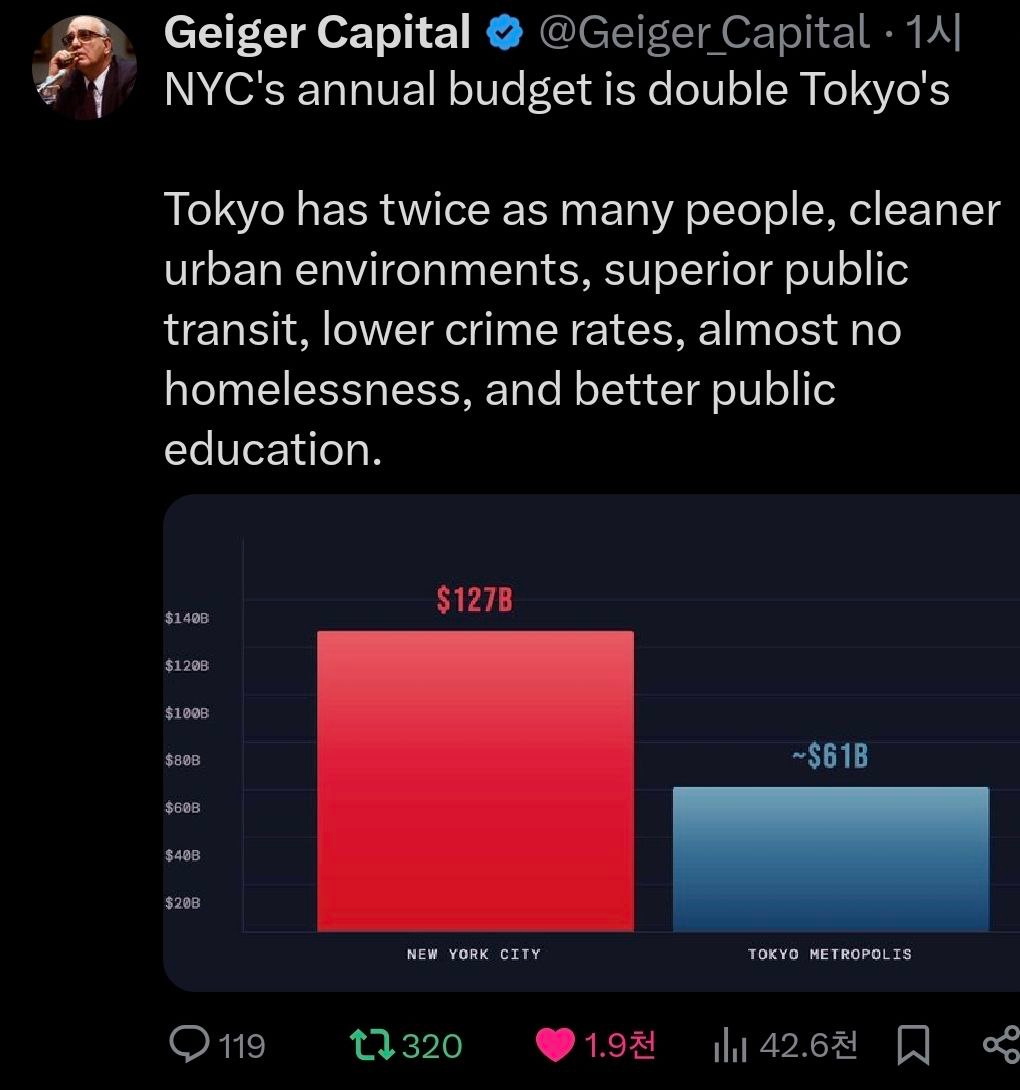
Guns are banned, they have strong environmental protection laws, and they have socialized medicine.
Japan doesn’t have socialized medicine. They have universal care. The government pays 70%. The user pays 30%. The insurance is provided through your employer. The doctors are private practice and not government employees. Guns are not banned but heavily restricted.
So the payment for healthcare is socialised. In low income households the government waives the 30% copay. Everyone is covered by law and fees are set by the government. All hospitals must be run as non-profits.
Handguns are completely banned which are the type of gun used in most crimes in the US. Rifles and shotguns are heavily restricted.
No, the health care does not meet the criteria for socialized medicine unless you want to ignore the meaning of words to create a new definition. Using your definition, America has socialized medicine. The Japanese system is closer to the American system than it is to the NHS, which is a socialized system.
I said firearms are restricted. That isn’t the same thing as a ban. The main reason Japan has such a low crime rate is its very conservative society.
If a Democrat put an exact copy of the Japanese healthcare system into a bill before US Congress, Republicans would be screaming it’s socialism.
South Africa has a very conservative society too.
The system isn’t that different than the American system. To call in a socialist system is factually wrong. The doctors are in private practice. The employer provides your insurance. If you can’t afford it or are elderly, it is provided. We have Medicaid and Medicare, which are the same thing. The only difference is that they are 70/30, and we are 80/20 in most cases. If they proposed that system in America, it would be a step backwards for most people.
https://www.bbc.com/news/world-us-canada-45817327
https://davidson.house.gov/2019/5/socialist-medicare-all-wrong-direction-america
https://thehill.com/opinion/healthcare/399283-medicare-for-all-is-a-socialists-dream-and-an-american-nightmare/
and? None of this has anything to do with Japan.
I am against Socialized healthcare. The NHS is a failure. Our current system works fine for most Americans. What many American don’t realize is we pay less in taxes but in return we pay at the time of use.
That statement alone discredits everything you say. “A record 23 % of Americans believe the United States healthcare system is “in a state of crisis” and 47% think it has “major problems,” according to a recent poll from the West Health-Gallup Center on Healthcare in America.”
https://www.theguardian.com/us-news/2025/dec/31/healthcare-americans-poll-data-insurance
deleted by creator
I think most people would point out their successful, homogeneous culture, and maybe even that they are quite Capitalist in other ways.
The subways there are also private (or largely private, I am not entirely sure).
Their culture isn’t any more homogenous than US culture. What you probably mean is they are racially homogenous, but it would be bad to imply that is superior.
Japanese trains were state owned until 1987. Once the majority of the tracks were laid (the expensive part), they handed it over for private management.
Another important element to Japans succes is that after WW2 they were banned from building a military which freed up a lot of money for social programs.
This is not accurate. Of course, regional differences are pronounced - it is not just the Kanzai that are distinct from greater Japan, but even within Kanzai the people of Kyoto represent a more traditional culture that is honor and prestige based while the people of Osaka tend to be direct, forthright, more hot-blooded and more expressive. Many say this is due to the traditional character of the cities - Osaka being highly mercantile and Kyoto being the traditional capital.
Yet, they are all Japanese, they have the same reference points, they have the same greater interests and cultural values, the same strange mix of Buddhism and Shintoism into a sort of national religion, and they have the same reference points within their political philosophies.
They are highly homogeneous.
I could talk all day about the regional differences and the socioeconomic classes within Korea, but still, there is cultural homogeneity.
Oddly enough, here it would be the center left that is even more inclined than the center right towards preserving this homogeneity and more expressive of a quiet ethnonationalism. Even the hard left seems inclined towards these views in the classic sense due to the influence of the North Korean communist narrative.
Sure, and half of the Seoul metro train tracks - or a bit more, IDK - are privately operated.
But yeah, the military spending is not a factor, but this is certainly true. The Europeans have tremendous welfare states because they have neglectedl military spending, and now they are FINDING OUT.
However, this is irrelevant to the NYC/Tokyo dichotomy.
Japan does have a military and they spend 2% of their GDP on it. That is more than most European nations.
.,… That is a really wild stat!
To put it in perspective. We allocate about 3% of our GDP to the military.