

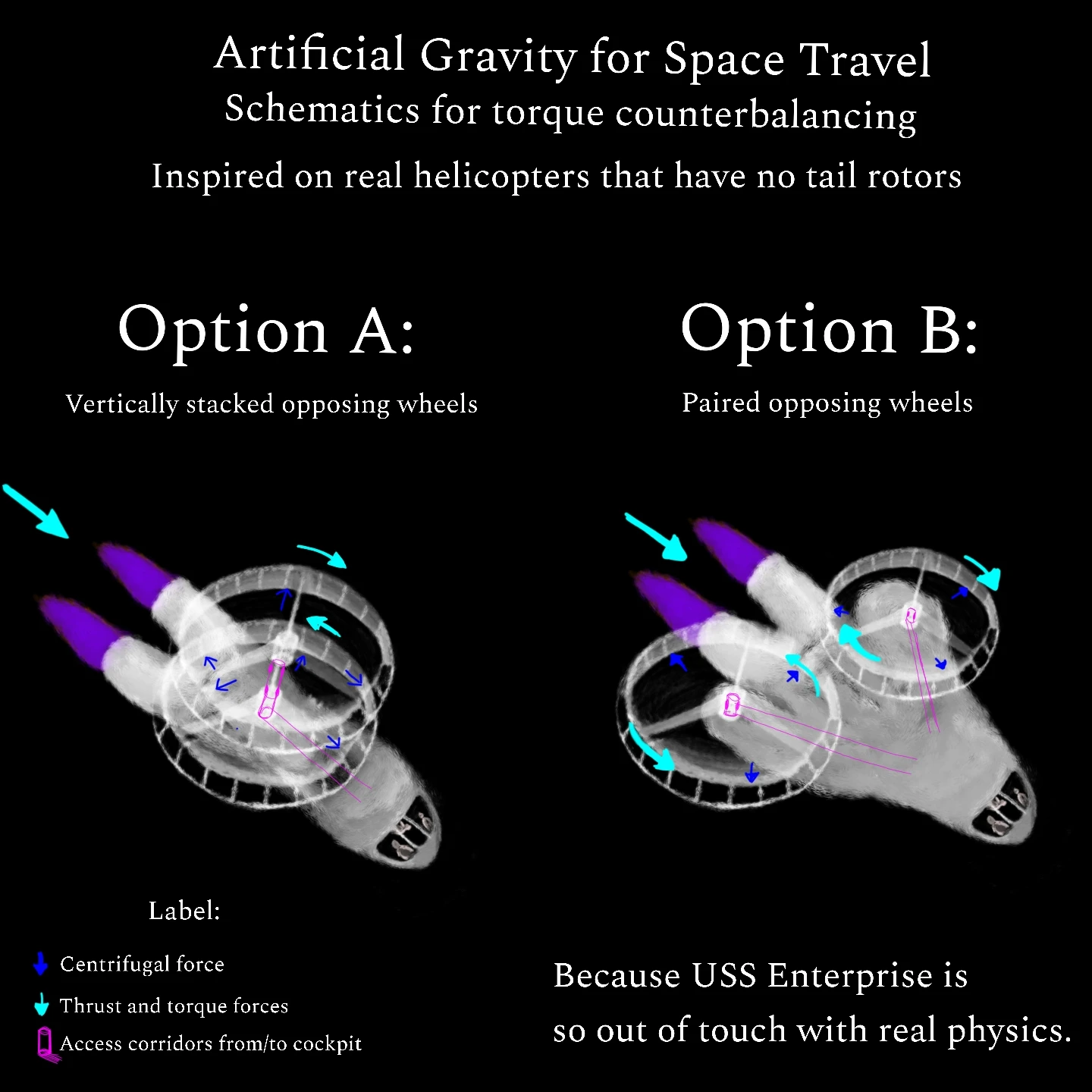
Putting the ART in ARTificial gravity
This is both an artistic experiment with engineering and a social experiment, given how my usual kind of art (occult symbolism, owls, etc) may feel too complicated for many and it’s often met with indifference. Yeah, aerospace engineering is also complicated (after all, it’s literally “rocket science”), but it feels to me like this kind of subject (hard sci-fi, Star Trek, etc) is more “socially sanctioned” in Fediverse than my usual kind of subject…
Given the latest happening involving my time-lapses (which I’ve been trying to post as a proof of human authorship), this time I’m not posting it. I do have the time-lapse for this art, if anyone is interested in seeing how I drew.
Alt-text:
A schematics-like digital art entitled “Artificial gravity for space travel: schematics for torque counterbalancing inspired on real helicopters that have no tail rotors”, divided in two panels.
Both panels feature a isometric view of a faintly translucent spacecraft with a gray hull and front-facing cockpit (whose window shows 3 people inside, one of them upside-down weeee-ing in microgravity behind the other 2) very similar in shape to the NASA’s Space Shuttle (I actually thought of it as I drew), but with a pair of big ionic thrusters (emitting a strong purple glow) at the rear, as well as a pair of large rotating rings attached to the top of the hull, meant as a centrifuge for artificial gravity. The rings, rotating in opposite directions so to cancel out a torque that would otherwise inflict attitude onto the ship (as per Newton’s 3rd Law), are attached through 3 equidistant I-beams to a smaller cylinder (which doubles as a hallway from/to the rest of the ship) which, in turn, is attached to the husk, in different configurations across the panels.
The first panel, “option A: vertically stacked opposing wheels”, is self-descriptive: the rings are on top of each other, rotating in opposite directions in the same axis, much akin to coaxial-rotor helicopters (e.g. Sikorsky S-69).
The second, “option B: paired opposing wheels”, features a configuration akin to transverse-rotor helicopters (e.g. Landgraf H-2), but with a wingspan slightly angled backwards. Each ring is attached to opposite wings.
At the bottom, there’s a label box, describing the meaning of each arrow overlaying both diagrams: cyan arrows represent both the thrust for the ship and rotation for the rings, while blue arrows indicate the gravitational force from the centrifugal motion. A third overlay, painted in magenta, shows the locations for hatches and corridors connecting the inside of each centrifuge to the cockpit and the rest of the ship.
There’s also a jab at Star Trek: “Because USS Enterprise is so out of touch with real physics”, nodding at how Spock and his crew were “simply” able to stand inside the ship as if gravity was something taken for granted outside a planet.
Ok so the thrust from the engines )let’s say we are at one g of thrust). That’s going to not work with your rings the way they are.
You have to think of the engines being “down” and the nose of the craft as “up”
Your rings should be going around the body of the ship. That way while under thrust the centrifugal force can work with the pseudo gravity provided by acceleration. What you have here would kill people
Tbf, 1g of thrust is a lot to assume, there are quite a few ways to do a high-efficiency rocket that result in extremely low thrust but applied for a long period of time. Still probably better to arrange them the way you suggest but I’m not sure it would be a huge problem for something like, say, an ion engine for example
I was using 1g of thrust just to simplify the point. But 1 G of thrust would be what you would want to aim for in a longe range space craft (barring fuel limits). It provides gravity without needing rotating hand.
If you are traveling from say planet a to planet b, 1 G constant acceleration halfway, flip and 1G acceleration (going backwards) to slowdown keeps your crew under steady gravity without rotating habitats.
(I read way too many hardcore space sci-fi books)
That’s the fastest way (barring unproven space warping whatever) to get around, but what sort of engine is going to give you both enough fuel efficiency and enough power at the same time to actually do that? Even nuclear rocketry struggles with that to my understanding unless the planets in question are very close.
According to sci-fi we ignore the whole “fuel thing” unless we hand wave it away with something like “Antimatter” or the like. :D
@CIA_chatbot@lemmy.world @artshare@lemmy.world
Back when I initially drew, I was thinking of some premises, including ionic thrusters (whose acceleration is knowingly slow) used only for changing the ship’s course which would essentially be wandering naturally (and unhurriedly) towards deep space, after being built in orbit (much akin to how ISS was built) then towed to orbit near escape velocities by detachable stages before leveraging gravitational assist, like the Voyagers did. In this sense, the centrifuge would be used during free roam through deep space, when the ship isn’t accelerating on its own. Also, the crew would be small (up to a dozen, but ideally three or five people, or an odd numbers of people), which would be floating in microgravity inside the rest of the ship (esp. the cockpit) most of the time.
But thinking about your design, rings around the ship instead of ships above/below the ship, yours is a better design than mine, because it’d also include a more efficient connection hallway to/from the rest of the ship.
I tried to draw it, keeping the pair of counterbalancing rings: