

3·
24 minutes agoDecided to be conservative and leave the Picatinny-rail-to-bayonet-lug piece on the top off, I see.
Decided to be conservative and leave the Picatinny-rail-to-bayonet-lug piece on the top off, I see.

Stewart (and Colbert) are literally a clown
what this job even freaken entails.
You know Volodymyr Zelenskyy, current president of Ukraine?
He’s a comedian who did a political satire TV series about being president of Ukraine.
https://en.wikipedia.org/wiki/Volodymyr_Zelenskyy
Born to a Ukrainian Jewish family, Zelenskyy grew up as a native Russian speaker in Kryvyi Rih, a major city of Dnipropetrovsk Oblast in central Ukraine. Before his acting career, he obtained a degree in law from the Kyiv National Economic University. He then pursued a comedy career and created the production company Kvartal 95, which produced films, cartoons, and TV shows including the TV series Servant of the People, in which Zelenskyy played a fictional Ukrainian president. The series aired from 2015 to 2019 and was immensely popular. A political party with the same name as the TV show was created in March 2018 by employees of Kvartal 95.
EDIT: Darn, someone else apparently mentioned it as well, checking their link. I’m still gonna leave this text up, though.
George Washington wasn’t able to attend school after the age of 11, because his father died and he had to take over running the family farm.
https://www.georgewashington.org/education.jsp
Despite being the Commander in Chief of the Continental Army during the Revolutionary War, the President of the Constitutional Convention, and the first President of the United States, George Washington’s level of education was far lower than any of the other Founding Fathers of the United States. In fact, he was often scorned by some of the other Founding Fathers for this inadequacy. However, this lack of education was not George Washington’s fault. Upon the death of George Washington’s father in 1743, George’s formal schooling ended. He is thought to have attended the nearby grammar school run by Reverend James Marye, the rector of St. George’s Parish, up until this time. Therefore, the extent of young George’s formal educational training was in basic mathematics, reading, and writing.
Although his older half-brothers had the opportunity to gain a formal education over in England at the Appleby School, George was required to take on the responsibility of running the family farm after his father’s death.
On this list, every ranking here places him as the highest-ranked President to ever serve other than one that places him at #2 and one that places him at #3:
https://en.wikipedia.org/wiki/Historical_rankings_of_presidents_of_the_United_States

deleted by creator

Yes. I wouldn’t be preemptively worried about it, though.
Your scan is going to try to read and maybe write each sector and see if the drive returns an error for that operation. In theory, the adapter could respond with a read or write error even if a read or write worked or even return some kind of bogus data instead of an error.
But I wouldn’t expect this to likely actually arise or be particularly worried about the prospect. It’s sort of a “could my grocery store checkout counter person murder me” thing. Theoretically yes, but I wouldn’t worry about it unless I had some reason to believe that that was the case.
Trump’s run on pretty anti-immigrant speech, but he’s pretty moderate in most other respects. He’s probably the least-religious president we’ve ever had, and ran for the “religion party” ticket; he had to run with Pence to make up for lack of appeal to social conservatives. He advocated for (well, or at least gave the impression of) fairly-protectionist policy and ran for the free trade party’s ticket. Since the start of the Cold War, the GOP’s tended to be the hawkish party, and he ran on a relatively noninterventionist platform (though I’ll concede that there’s always been a paleoconservative isolationist faction, but it’s been relatively weak for quite some decades).
Trump constantly says outrageous stuff – he definitely makes it a point to be politically incorrect – but his policy is actually not especially exciting.
I looked at his website way back in the 2016 election before his campaign had built up any steam. This was back when Hillary was running a nice, typical website, long list of issues, you know what campaign websites normally look like. At that point in time, he – hillariously – had only three issues on his campaign website. And none of his actual positions represented much of a change from the status quo:
Opposition to FTAs; at the time, we had been negotiating TPP with the Pacific Rim countries and TTIP with the EU. Both had effectively failed already at this point. Trump gave the public the impression that he was responsible for this, but it was something that was going to happen under Obama or not. He also spent a long time complaining about NAFTA. Thing is, I already had listened to speeches from a few politicians who had played this game with NAFTA (e.g. Ron Paul complains a lot about NAFTA but is quieter about why he opposed it, because it wasn’t permissive enough, whereas most people listening to him are upset that it isn’t restrictive enough). I had a pretty good guess that Trump was going to pull similar shennanigans on policy, looked at his white paper and sure enough, no specific changes, just lots of fluffy emotional text giving the impression that he was in opposition. And in office, he took NAFTA, negotiated a few minor changes, and then renamed it to USMCA. Having kicked the legs out from decades of time that manufacturing unions had built public opposition to NAFTA, he left the thing alone. So, he advocated for a position that sounded unusually close to the position that the folks on the left side of the spectrum wanted and, in fact, essentially left existing policy alone.
Opposition to immigration. Now, you could make a fair argument that he worked pretty hard to sell a nativist image. But his actual policy also wasn’t particularly notable. He put through one regulation that SCOTUS was pretty sure to shoot down and kept it a constant source of political theater for a significant chunk of his term. He made an enormous deal out of his wall, kept it in the news, gave the impression without ever saying so that he was going to build a wall along the entire border. But this isn’t even a new game to play from Trump. Bush Jr used the same shtick back when he ran. In his case, it was a “fence” and played a less-prominent role in his campaign.
Gun rights. He has no specifics and this is trivial to do: just don’t involve yourself in additional restrictions. This has been a pretty stock generic Republican point because it costs nothing to do ever since the Democrats did the federal Assault Weapon Ban, which was not popular and sunsetted; it’s something that every candidate just slaps on their page.
Hell, Trump was a Democrat back when Bush Jr was in office.
But Trump is far right. The news says so.
If you read news media that favors the Democratic Party, it will say that Trump is far right. If your regular news sources favor the Democratic Party, you have probably read a lot of articles over past years that say that.
If you read news media that favors the Republican Party, you will find plenty of material that will say that Biden is far left.
But Biden’s not far left! That’s ridiculous!
Yup. But presenting someone as being extreme is a good way to make them less appealing. You can find people who will self-identify as “left-of center” or “right-of-center”, even “left” or “right”. But very few politicians will call themselves “far left” or “far right”. That’s usually a label used by the media favoring the other side.
There are a lot of things that I don’t like about Trump. But they mostly deal with his presentation and the tactics he uses. I dislike his willingness to make contradictory statements. I don’t like the fact that he tries to piss people off about someone else – especially via dishonest claims – and exploit that anger. I dislike his willingness to disregard the political-consensus-building role that elections have, to concede, though I’ll grant that maybe if there’s a problem there, it needs to be fixed in the underlying system. But he’s extraordinary mostly in his presentation, not in the policy that he’s adopted. We had him for four years. US policy didn’t change much, certainly not from mainstream Republican Party policy.
When Trump first ran for office, I remember Bill Kristol – a conservative commentator who really dislikes Trump – stating that most of what Trump says is misdirection. Basically, Trump can’t force the media to say what he wants. But he can make a colossal amount of noise about something outrageous that they cannot resist covering, so that they talk about that instead of whatever meaningful actual policy stuff is going on. The coverage may not be positive, but it lets him direct the media narrative – it’s all about whatever outrageous thing he said on Twitter. I was a bit skeptical at the time. I could believe that Trump wouldn’t change much on NAFTA because I’d seen other Republican politicians play the same game he was, but had a harder time buying that on immigration. But that was, I think, pretty accurate as an assessment. Most of what is unusual about Trump are the outrageous things that come out of his mouth when he’s politicking. It’s not really his policy.
I believe that candidates from a given area are expected to perform disproportionately-strongly in the state that they’re coming from. Sometimes I’ve seen Presidential candidates coming from large states, with commentary that they’ll bring that state’s support to the table.
That being said, I don’t have numbers available.

I mean, you can probably create something akin to a god, but I don’t see as to whether it being open source or not would change that.
Also, fun trivia bit:
They could say “now the rules are we choose a random US citizen”.
There were historically some systems of government who not merely had random people chosen as candidates, but random people chosen to run the society.
https://en.wikipedia.org/wiki/Sortition
In governance, sortition (also known as selection by lottery, selection by lot, allotment, demarchy, stochocracy, aleatoric democracy, democratic lottery, and lottocracy) is the selection of public officials or jurors using a random representative sample.[1][2][3]
In ancient Athenian democracy, sortition was the traditional and primary method for appointing political officials, and its use was regarded as a principal characteristic of democracy.[4][5] Sortition is often classified as a method for both direct democracy and deliberative democracy.
I’d add that I don’t at all agree with some of the people in this thread, who are on the left end of the spectrum and mainly seem to be hoping that the Democratic Party will select someone further left than Biden because they personally would prefer a further-left candidate. In the American electoral system, voting is FPTP. That means that you tend to wind up with two large, big-tent, fairly centrist parties (which approximate party coalitions in parliamentary systems), and the smart move for each to win general elections is to run a centrist candidate.
A Big Two party can nominate someone out on the fringes, but then they will cede the general election to the other party if the other party runs a centrist candidate.
In fact, a major argument against primaries is that they may tend to choose a suboptimal candidate for the general election, since they tend towards electing candidates towards the center of the political party, and that that a more-winning strategy for a party is to choose someone not at the center of their party’s views, but between that and the center of the general electorate, and that the party members are more-likely to make use of strategic voting than are members of the electorate that votes for their party’s candidate.
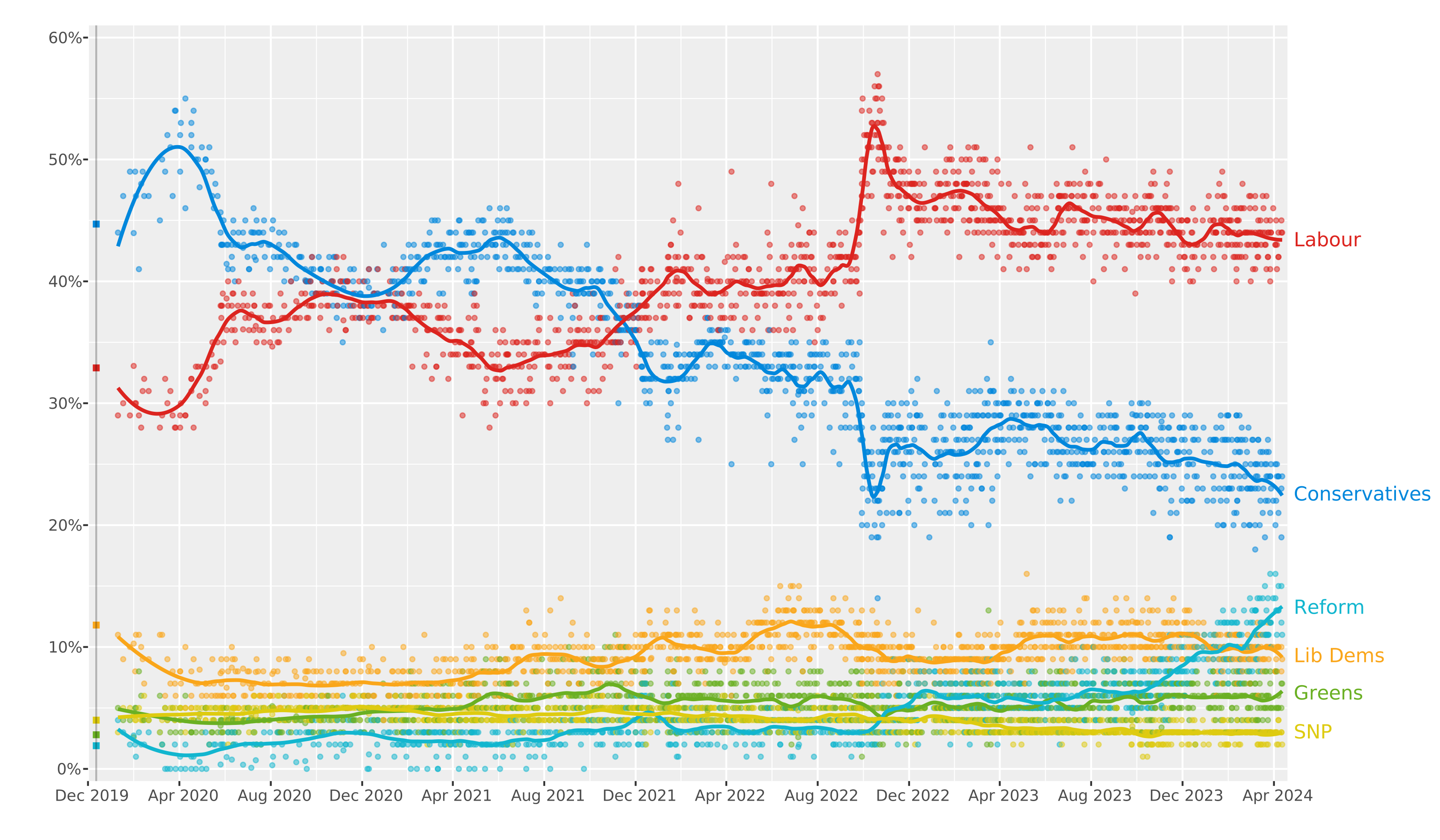
I watched a very similar discussion play out on British political forums over the past decade or so. Due to Labour changing some internal party policies that lowered the bar to party membership, party voting changed. Some left-advocacy groups organized a campaign to get people on the left side of the Labour spectrum to become members, to act in the party candidate selection process, and as a result, Jeremy Corbyn – who is on the left end of the Labour spectrum – was chosen as Labour candidate. There were people who were absolutely convinced that running Jeremy Corbyn would be a stupendously winning strategy because they personally were politically closer to Corbyn and couldn’t imagine why anyone else would vote against him. I watched Tony Blair give a talk where he pointed out that unless a political party wins elections, it doesn’t get to have political power, and that while he was a centrist candidate, he actually won elections and that Labour had mostly been out of political power for an awfully large portion of recent British political history. Sure enough, Labour proceeded to run Corbyn twice and were clobbered in two elections. Now they’re back to the comparatively-moderate Keir Starmer and based on polling, are looking at having strong results in the imminent election.
EDIT: If you want a great graph illustrating the Corbyn situation, here’s a graph of polls of voting intent for the next UK election. Corbyn lost the leadership position (which in the UK’s political system, also normally grants one the prime minister’s office in the event that one’s party wins) in April 2020, to provide time context.
the TL;DR is that the party can’t just replace Biden.
The Democratic Party can run whoever it wants. The primaries and party nomination are (mostly) party-internal processes. They could say “now the rules are we choose a random US citizen”. They don’t have to do a primary at all. Some parties don’t. There was a point in time in US history when primaries weren’t a thing, and parties were quite happily doing their thing back then.
kagis for a starting date
https://en.wikipedia.org/wiki/Primary_election
The direct primary became important in the United States at the state level starting in the 1890s and at the local level in the 1900s.[17] The first primary elections came in the Democratic Party in the South in the 1890s starting in Louisiana in 1892.
The United States is one of a handful of countries to select candidates through popular vote in a primary election system;[12] most other countries rely on party leaders or party members to select candidates, as was previously the case in the U.S.[13]
EDIT: As a good example, the Libertarian Party – though much smaller than the Big Two – is the next closest. Under their rules, they participate in primaries, but they treat the primary simply as a way to obtain the preference of the electorate; the primary doesn’t bind the party, under their rules.
https://en.wikipedia.org/wiki/2024_Libertarian_Party_presidential_primaries
The Green Party has a mix of conventions and primaries, depending upon state; a random member of the electorate may-or-may-not directly vote to select their party’s candidate.
I don’t really have a problem with this – I think that it’s rarely in a consumer’s interest to choose a locked phone. Buying a locked phone basically means that you’re getting a loan to pay for hardware that you pay back with a higher service price. But I’d point out that:
You can get unlocked phones and service now. I do. There are some privacy benefits to doing so – my cell provider doesn’t know who I am (though they could maybe infer it from usage patterns of their network and statistical analysis). It’s not a lack of unlocked service that’s at issue. To do this, Congress is basically arguing that the American consumer is just making a bad decision to purchase a plan-combined-with-a-locked-phone and forcing them not to do so.
Consumers will pay more for cell phones up front. That’s not necessarily a bad thing – it maybe makes the carrier market more competitive to not have a large portion of consumers locked to one provider. But there are also some benefits to having the carrier selecting cell phones that they offer in that the provider is probably in a better position to evaluate what phone manufacturers have on offer in terms of things like failure rates than do consumers.

Being libertarian doesn’t need mean one’s an anarchist (or even a minarchist!).
And he’s also libertarian in the sense that the unadorned word has been used in the US, a right-libertarian, rather than how it was historically used in Europe in an unadorned sense, left-libertarian, where I’d say that it was somewhat-closer to anarchism than the more small- or minimal-government right-libertarianism.

Why did they do this?
Probably because Ariane 6 is a new rocket, and new rockets haven’t had the bugs worked out and have a disproportionately high failure rate.
But now, on the eve of restoring European access to space, Eumetsat has effectively stabbed this industry in the back.
That is not too strong of language, either. In its release, Eumetsat described its new Meteosat Third Generation-Sounder 1 satellite as a “unique masterpiece of European technology.”
Good grief.
NASA flew the James Webb Space Telescope on Ariane 5 for exactly the same reason – because it was an extremely-expensive payload, and when they expected to launch the thing, Falcon was immature, and Ariane 5 was mature. I didn’t hear people running around saying that the US had “stabbed American rocketry in the back” by launching something on France’s baby. Hell, we spent a long time launching stuff on Russian rockets, which I think probably has a lot more potential for controversy.
However, even if that strategy is somehow successful, again, and Biden does manage to get reelected, the Democrats MUST nominate a better candidate in 2028.
The Constitution mandates a maximum of two terms for a President. If he wins, he can’t run again. He can technically additionally serve up to half of a term without “using up” one of his terms if he’s vice-president and the serving President dies.
The two-term limit was originally purely a convention that had been set by George Washington, who was getting on in years, wasn’t many years away from his death, really wanted to retire to his plantation (as in, he didn’t even want to serve a second term, and was only convinced to do so by politicians arguing that without him, there might not be sufficient unity), and was also extremely popular and would have been re-elected again.
That convention held until FDR broke it and ran for four terms. In response to that, the Twenty-second Amendment was passed, prohibiting anyone from having more than two terms.
https://en.wikipedia.org/wiki/Twenty-second_Amendment_to_the_United_States_Constitution
and the U.S. is considering not re-installing it unless aid begins flowing out into the population again, several U.S. officials said Friday.
Honestly, this was a ludicrously cost-ineffective way to transport aid. We built the thing remotely, floated it in, and it was only there for a few weeks before a storm caused damage and grounded multiple ships. We repair it. Then the UN decided that they weren’t going to use it for delivery because one of their warehouses had been hit (just dump it on the beach at Rafah, guys, if you don’t want to use the warehouses, has to be better than not bringing it in).

I mean, if you want to play a game made by volunteers, that’s where Team Fortress came from.
There originally was the Quake-based Team Fortress mod.
There was Weapons Factory for Quake II, which was similar.
The TF team was hired by Valve to do the confusingly-named Team Fortress Classic for Valve’s Half-Life, itself based on Quake II.
And Valve did Team Fortress 2.
Only HR, IT, and management are believed to be unaffected by the cuts, which reportedly would see the developer’s title, 2016’s Disney Magic Kingdoms, transferred to Gameloft’s studio in Kharkiv, Ukraine.
Kharkiv? Damn. I mean, Kharkiv is an active war zone. As in “I read regular news reports about fighting there”.
This was today:
https://kyivindependent.com/russia-attacks-kharkiv-with-fab-500-bomb-for-first-time-injuring-4/
Russia attacks Kharkiv with FAB-500 gliding bomb for first time, injuring 4
searches further
And it’s not just casually using the term to refer to Kharkiv Oblast, either. The studio is in the city, slightly on the Russia side.
10 Nezalezhnosti Ave, BC Kvartal, 61022 Kharkiv, Ukraine
EDIT: They aren’t in the district that was bombed above, but they’re one block away from said district.
I mean, the whole thing doesn’t need to be destroyed for a bunch of pieces to be broken off.




















Lemmy is not designed to provide reasonably-hardened anonymity in the sort of way that Hyphanet, I2P, or maybe Tor or something like that is.
I would not recommend using Lemmy if I were seriously concerned about government prosecution for content on it.
Lemmy’s a good alternative for something like Reddit.